Queen Anne’s Lace or Poison Hemlock? Why Every Herbalist Learns to Tell Them Apart
CONTENT SUMMARY
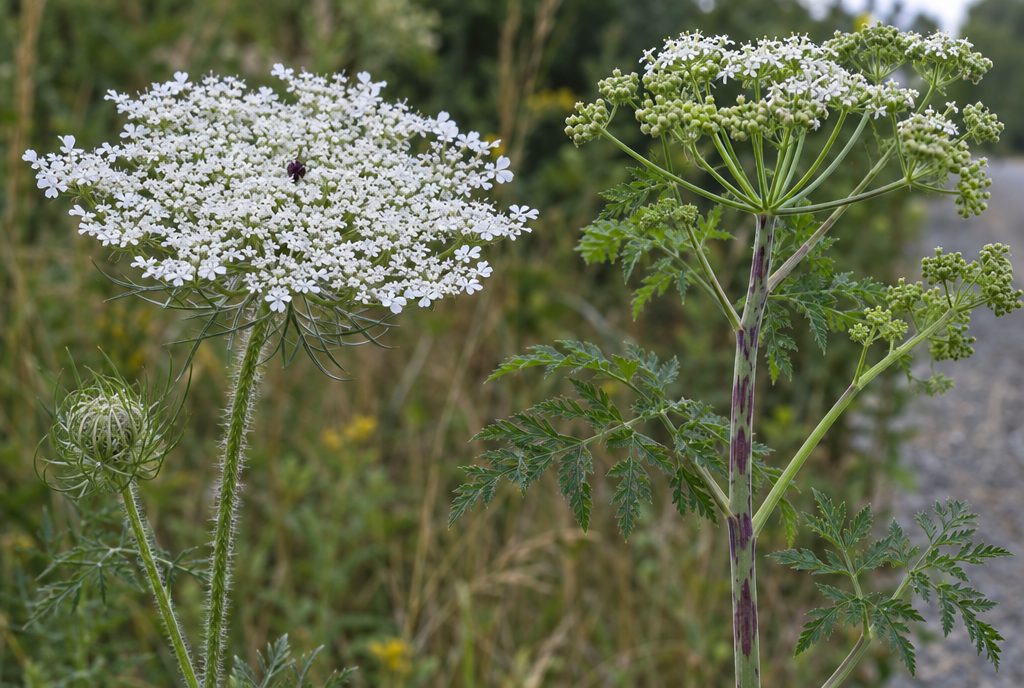
Drive any country road in late summer and you will pass both of them in the same ditch, both waist high, both topped with flat white clusters of tiny flowers. One is wild carrot, known as Queen Anne’s lace. The other is poison hemlock, the plant that killed Socrates. Here are the five differences, why they matter more than any other lesson, and the habit they build.
- Hairy stem means Queen Anne’s lace. Smooth stem with purple blotches means hemlock. Check every time.
- No single clue is enough. An herbalist checks all five, and walks away when any one is wrong.
- Everything else in herbal study rests on identification. Get the plant wrong and the rest of your knowledge is pointed at the wrong thing.
By Brooke Freedom · Kingdom University of Natural Medicine · October 2026
Five differences you can see and smell
- Stem. Queen Anne’s lace has a hairy green stem. Poison hemlock has a smooth stem with purple or reddish blotches.
- Center of the flower. Queen Anne’s lace usually carries one tiny dark red or purple floret in the middle of the white cluster. Hemlock does not.
- Smell. Crush a leaf of Queen Anne’s lace and it smells like carrot. Hemlock smells musty and unpleasant.
- Height. Queen Anne’s lace stands two to three feet. Hemlock can reach eight.
- The cluster. Queen Anne’s lace often curls inward into a bird’s nest shape as it ages. Hemlock stays open.
No single clue is enough on its own. An herbalist checks all of them, every time, and when any one is wrong, walks away.
Why this matters more than any other lesson
Everything else in herbal study depends on knowing which plant is in your hand. Preparation, tradition, history, the green herbal pharmacy: all of it assumes identification is already settled. Get the plant wrong and the rest of your knowledge is pointed at the wrong thing. That is why Kingdom University teaches identification before anything else, and why we teach it the way botanists do, with leaf, stem, flower, smell, habitat and season together instead of a single photograph.
A note on safety
Poison hemlock is dangerous to handle as well as to eat. Do not pull it bare handed, do not burn it, and keep children and pets away from it. If you are not certain which plant you are looking at, you are looking at hemlock until proven otherwise.
The habit it builds
Students who train this way develop a habit that stays with them for life: they do not trust a plant until it has proven what it is. That habit is the difference between an herbalist and a person who likes plants. It is a habit you can learn at your kitchen table. Every course is delivered by correspondence and through the student portal, with a personal tutor and a pace you set.
TRY THIS WEEK
- On your next drive, spot the white umbels in the ditches. Count how many you see in ten minutes.
- Stop safely at one patch. From standing height, check the stem for hairs or purple blotches. Do not touch.
- Look for the single dark floret in the center of a flower cluster.
- Write down which plant you think it is and why, in one line. That is the whole method.